Breaking the Trauma Cycle: What Actually Happens When You Stop Running
Something happened to me recently that I want to share with you. Not because it was dramatic or life-changing in the way those moments usually get described. But because it was quiet. And because it showed me something about my own framework that I had understood in theory but never quite lived.
Breaking the trauma cycle does not mean forcing yourself to feel differently. It means staying with what your body is already doing instead of running from it. The trauma cycle is the automatic loop your nervous system runs when it detects a threat: trigger, body response, survival behaviour, brief relief, repeat. Breaking it happens when you catch the moment between the body responding and the survival pattern taking over, and you stay there instead of following the old script.
I know this because I work with it every day in my therapy practice, and because I experienced it myself. I was sitting with a familiar feeling. Pressure from the masters degree, the counselling work, the visibility of putting myself out there. Old comparison patterns running underneath.
And then I noticed my chest. A pulsing weight. Tightness. The kind of fear that sits in the body before the mind has any idea what is happening.
If you have ever experienced something like that, where your body seems to be telling you something your thoughts have not caught up with yet, then you already know what breaking the trauma cycle actually begins with. Not a decision. Not a technique. A moment of noticing.

What the Trauma Cycle Actually Looks Like
The trauma cycle is an automatic loop that runs in your nervous system whenever it detects something that feels like a past threat. Most people think of trauma as a single event, something that happened to you once. But trauma lives in patterns, and those patterns repeat.
I call this the Survival Cycle, a six-stage framework that maps how the body responds to perceived threat. The order matters more than most people realise, because the body responds before cognition. This is what makes it distinctive.
It starts with a trigger. Something in the present that echoes a past threat. It does not have to be obvious. A tone of voice, a feeling of exclusion, uncertainty, even tiredness. The danger is assigned by your nervous system, not by the event itself.
Then the body responds. Before any thought. Before any feeling you can name. Your heart rate shifts, your breathing changes, muscles tighten, your gut constricts. Your body has decided you are not safe, and it made that decision before your mind got involved.
Next comes the survival response. Your nervous system selects what once kept you alive: fight, flight, freeze, or fawn. This is not a choice. It is a learned pattern from childhood, a strategy your body adopted because it worked when you were small.
Then state. Your window of tolerance in that moment. Shaped by how much sleep you have had, how much stress you are carrying, how safe your relationships feel right now. This is why the same trigger can feel manageable on Tuesday and completely overwhelming on Thursday.
The mind responds next. And this is the part most people assume comes first. The urgent thinking, the inner critic, the story your brain creates to explain what your body is already doing. "You are not good enough." "Something is wrong." "You need to fix this." That is not truth. That is your mind trying to regain control of a process that started without it. Sometimes the story the mind creates is one of toxic shame, a deep feeling that you are fundamentally wrong as a person, rather than simply struggling with a moment.
Finally, protective behaviour. The output of the whole cycle. Overworking, scrolling, withdrawing, people-pleasing, numbing. Not character flaws. The end point of a process that began before you were aware of it. If you have ever found yourself shutting down emotionally and not knowing why, this is the process behind it.
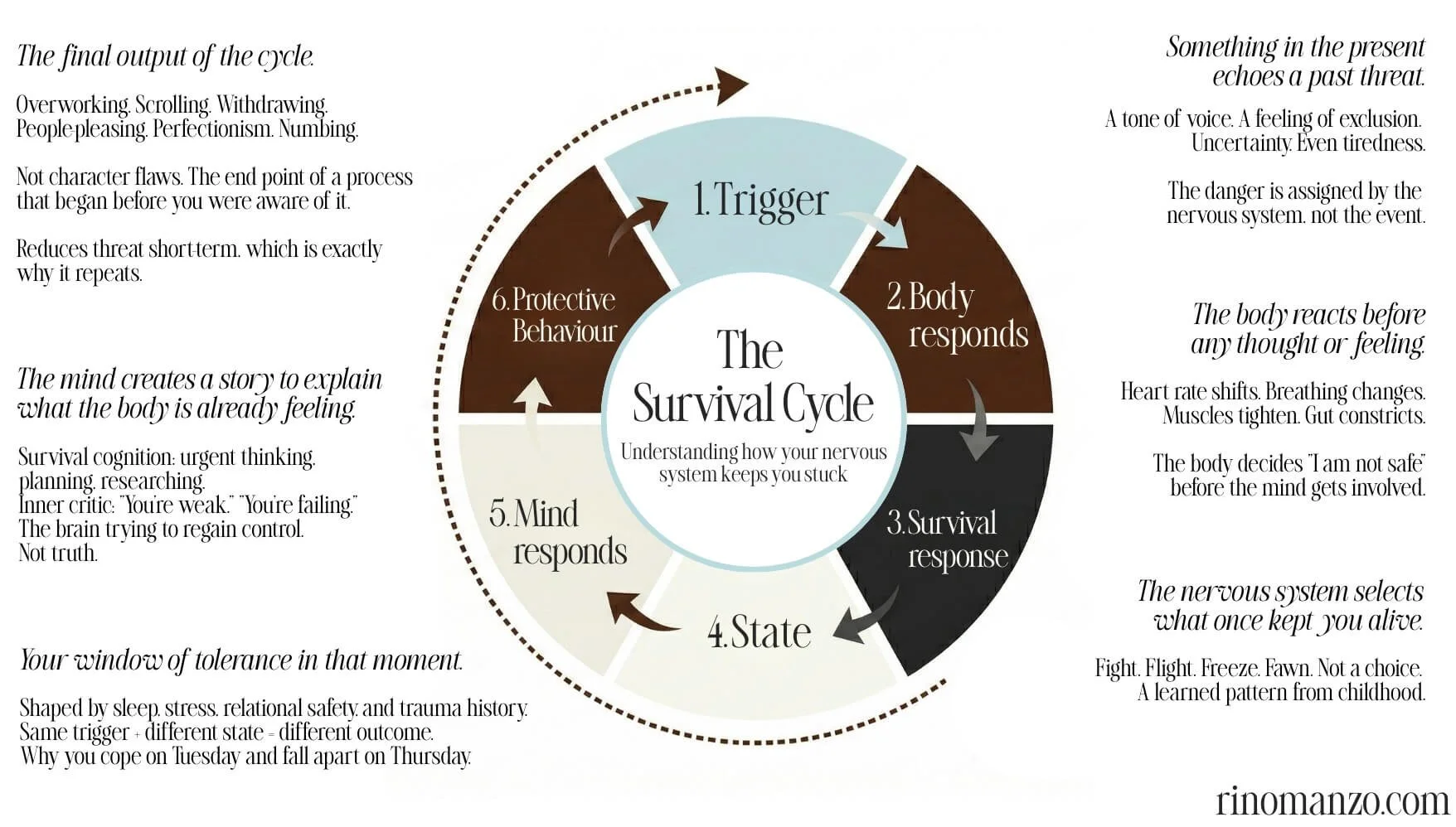
And here is the part that keeps the cycle running: the behaviour works. Briefly. It reduces the threat. You feel a moment of relief. And because it worked, your nervous system files it away as the right thing to do next time. The cycle strengthens. This is what I mean when I talk about how the body learns to cope. These are not broken reactions. They are learned loops.
How the Cycle Runs Differently for Each Survival Response
The cycle is the same six stages every time, but it looks different depending on which survival response your body learned. Understanding your particular version of the cycle is often the first step toward recognising when it is running.
If your body learned the freeze response, the trigger lands and everything goes heavy. Not ordinary tiredness, but a full-body shutdown. Your nervous system has decided the safest thing is to become very still, very small, very quiet. Your mind tells you that you are lazy, that you do not care enough. Your protective behaviour is withdrawal. Cancelling plans, going silent, sitting in front of a screen without really seeing it. From the outside it looks like disengagement. Inside, it is overwhelm.
If your body learned the fight response, the cycle moves fast. The trigger hits and your body floods with heat. Jaw tightens, everything speeds up. Your survival response is to push back, with words, with challenge, with an energy that resists whatever feels threatening. Your mind tells you the world is unfair, that people are taking advantage. The protective behaviour looks like anger, reactivity, arguments that escalate before you know why. The anger does not feel like fear. But that is exactly what it is.
If your body learned the fawn response, the cycle is the hardest to spot because it looks so much like being a good person. The trigger lands and your body tightens into a kind of attentive scanning, reading the room for what everyone else needs. Your survival response is to make yourself useful, agreeable, invisible in the way that pleasant people are invisible. The protective behaviour is saying yes to everything, absorbing other people's feelings, putting yourself last and calling it generosity.

If your body learned the flight response, the cycle is disguised as productivity. The trigger lands and your body fills with restless energy. You cannot sit still. Your survival response is to move, to plan, to stay one step ahead. The protective behaviour is overwork, over-scheduling, constant busyness. If you stop, the feeling catches up. So you do not stop.
Four different patterns. But the same cycle underneath. Trigger, body, survival response, state, mind, behaviour, relief. And relief is what locks it in.
Breaking the Trauma Cycle: The Two Paths
Breaking the trauma cycle happens at a specific point in the sequence. There is a fork between the body responding and the survival response fully taking over. It is not a fork you choose consciously. But it exists, and once you know it is there, the cycle stops feeling inevitable.
What happened to me that day was that my body responded. I felt the fear, the pulsing weight, the tightness. And instead of the usual pattern kicking in, instead of reaching for distraction or pushing harder or going numb, something else happened. I stayed. Not because I decided to stay. Not because I used a technique. I just noticed what was happening in my body and did not move away from it.
Path One is the survival loop. The one that protects you and costs you at the same time. Trigger, body, survival response, mind, behaviour, relief, repeat. The cycle continues because the relief reinforces it.
Path Two is what happens when you stay. Trigger, body, and then a pause. Not a forced pause. Not gritting your teeth and trying to be present. More like the body recognising that the threat is not as immediate as it feels, and the survival response not fully activating.

When I stayed with what my body was doing, the urgency started to settle. The mind still showed up with questions. "Why is this happening again?" "What does this mean?" But the questions did not have the same pull. They were just questions. Not commands.
And then something else came through. A calm that was not the calm of distraction or the calm of exhaustion. Something underneath the whole cycle. Something that had been there all along but was normally buried under protective layers. I am not describing enlightenment. I am describing what happens when your nervous system trusts the present moment enough to let go of the protection it has been running since childhood.
Why Breaking the Trauma Cycle Is Not What Most People Think
Most advice around breaking the trauma cycle falls into one of two categories. Either it tells you to stop the feeling (manage your triggers, control your reactions, use coping strategies) or it tells you to replace the behaviour (swap scrolling for journaling, swap avoidance for exposure). Neither of those is wrong, exactly. But neither addresses where the cycle actually lives.
The cycle lives in the body. It starts in the body. It repeats because the body learned it. And breaking it, the real kind of breaking it, happens in the body too. What I experienced was not me overriding the cycle with willpower. It was my nervous system finding enough safety to try something different.
That is an important distinction. You cannot force your way out of a survival response. Your body will not let you. It learned that response for a reason, and it will not abandon it until something more convincing than logic tells it that the danger has passed. That something is not a technique. It is a felt sense of safety. And that felt sense comes from the body, not from thinking.
This is why trauma therapy works differently from what many people expect. It is not only about talking through what happened. It is about helping your nervous system learn, in real time, that the present moment is not the past. That the danger your body keeps responding to is a memory, not a reality.
The Fork Is Not a One-Time Event
What I described, the moment where I stayed instead of running the cycle, was not a permanent fix. The cycle came back. It always comes back. Your nervous system does not abandon decades of learned protection because of one good moment.
But here is what changes. You learn that there is a fork. You learn that the cycle is not inevitable. And you learn, not in your head but in your body, that staying does not kill you. That knowledge accumulates. Each time your system reaches the fork and tries Path Two, even briefly, even imperfectly, the pathway strengthens. Not because you are training yourself like a habit app. But because your nervous system is updating its threat map. It is learning that the present is not the past.

This is what healing from trauma actually looks like. Not a straight line. Not a breakthrough followed by permanent change. A gradual widening of the space between trigger and response. A growing trust between you and your own body.
You are not broken. Your body learned to protect you. It did an extraordinary job. And now, slowly, with enough safety, it can learn something new. You do not have to force the fork. You do not have to find the calm. You just have to notice the body, name what is there, and stay. That is enough. That has always been enough.
If any of this sounds familiar, and you would like someone to sit with you while your nervous system learns that it is safe to try something different, I offer trauma therapy online from anywhere in the UK. You can also explore whether anxiety therapy, depression therapy, or talking therapy might be the right starting point for you.
A Soft Next Step
I am not currently taking on new clients, but I am keeping a waitlist. If something here has landed, you can add your name and I will be in touch as soon as a space opens. No pressure and no commitment, just a way to stay connected for when the time feels right.
Frequently Asked Questions
-
Breaking the trauma cycle means interrupting the automatic loop your nervous system runs when it detects a threat. The cycle moves from trigger to body response to survival behaviour to temporary relief, and then repeats. Breaking it does not mean stopping the feelings. It means learning to stay with what your body is experiencing rather than following the automatic response. Over time, this creates a new pathway where your system can settle without needing the protective behaviour.
-
You can begin to notice the cycle on your own, and that awareness is genuinely valuable. But trauma lives in the body and in the nervous system, not just in thoughts. Working with a therapist, particularly one trained in trauma, gives your nervous system something it cannot easily give itself: the experience of being safely held while the body processes what it has been carrying. That relational safety is often what makes the difference between understanding the cycle and actually stepping out of it.
-
There is no fixed timeline. The cycle developed over years, sometimes decades, and it does not unlearn overnight. What most people notice is a gradual widening of the space between trigger and response. You start to catch the cycle earlier. The survival response still activates, but it does not run all the way to the end every time. This is not failure. This is exactly how healing works: slowly, in layers, with the body learning at its own pace.
-
Because the pattern works. Not in the way you want it to, but in the way your nervous system needs it to. The survival response reduces the immediate sense of threat, and that moment of relief teaches your body to do the same thing next time. It is not weakness or self-sabotage. It is a loop that reinforces itself because it achieves what it was designed to achieve: keeping you safe in the short term.
-
Coping manages the symptoms. It gives you strategies to get through the moment, which matters. Healing changes the underlying pattern. When you cope, the cycle still runs but you handle the output better. When you heal, the cycle itself starts to shift. Your body learns that the threat it keeps responding to belongs to the past, not the present. Both have value. But only one changes the loop.
-
Fight, flight, freeze, and fawn are one stage within the larger cycle. They are the survival responses your nervous system selects when it detects danger. But the full cycle includes what happens before the survival response (the trigger and the body's reaction) and what happens after it (the mind's story and the protective behaviour). Understanding the full cycle matters because it shows you where the pattern can be interrupted, which is earlier than most people think.
Related Articles