What Is Trauma? Understanding How the Body Learns to Cope
Most people have heard the word trauma.
When they hear it, they often think of something extreme. War. Abuse. A single event that changes everything.
So if I asked most people, "Have you experienced trauma?", many would say no. Nothing like that has happened to me.
But when you listen more closely, the body often tells a different story.
People feel anxious, on edge, shut down, or overwhelmed, and they do not always know why. I hear this often in my work. People sit down and say, "I do not know what is wrong, but something does not feel right."
Trauma can come from one big event. For many people, it develops quietly over time.
It often comes from growing up without enough emotional support. Not being noticed. Not being soothed. Being left alone with feelings that were too much to manage alone.
This article explains what trauma is, how it forms in the body, and why it can continue to affect people long after the original experience has passed.
What trauma actually is and how it lives in the body
The word trauma comes from an ancient Greek word that means wound.
That already tells us something useful.
Trauma is not the event itself. Trauma is what remains after the event has passed.
I often pause here because people usually ask whether this means trauma is not in the mind.
Yes. That is what I am saying.
If I fall and hurt my leg, I can see the injury. My body reacts, it hurts, it heals, and over time it settles. We understand that easily.
With trauma, the wound is not visible. It is held in the body.
Trauma is the way the body learned to respond when something felt overwhelming, and how the nervous system adapted to survive.
How trauma forms in childhood
A simple way to understand trauma is this.
Trauma happens when something is too much, too soon, or faced alone.
In those moments, the body cannot cope with what is happening, and there is no support to help it settle. So the body adapts.
That adaptation is the wound.
This is more likely to happen in childhood. Children cannot manage strong feelings on their own. They rely on adults to help them calm down, feel safe again, and return to balance.
When that support is missing, the feeling does not disappear. It stays in the body.
A Simple Example
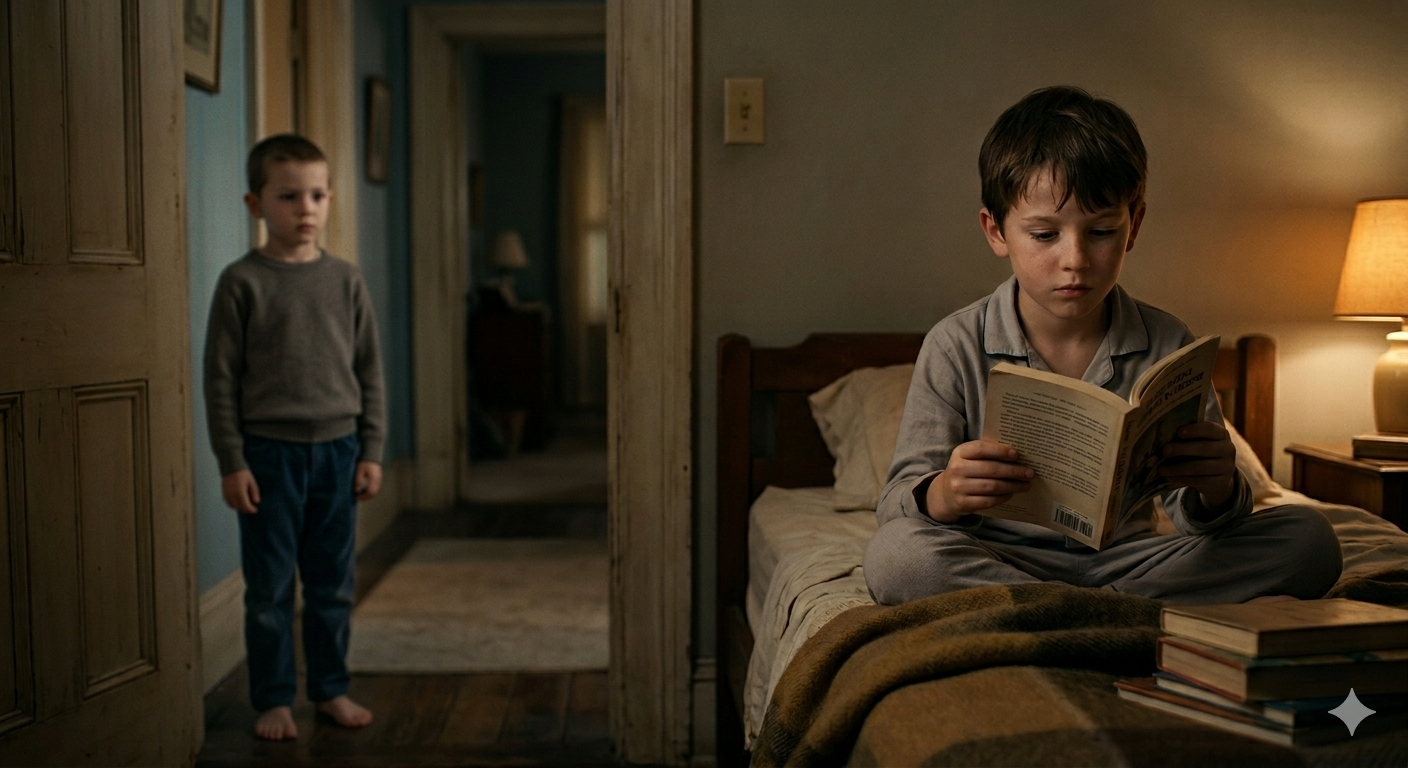
Imagine two children growing up in different families.
Both feel scared or upset at times. Both need comfort and reassurance.
The difference is not the child. The difference is what happens next.
In the first home, when the child is upset, his mother turns towards him. She notices. She stays with him. She helps him calm down. He cries, his body releases the fear, and his system settles. The moment passes.
Nothing gets stored.
The second child’s experience is different.
His mother is emotionally focused on herself. When he is upset, she becomes cold, irritated, or dismissive. She may respond only when he is being easy or pleasing.
There is no obvious abuse. He is fed, clothed, and goes to school.
But emotionally, something important is missing.
When he feels overwhelmed, there is no one there to help him settle.
This is the moment that matters.
His body has to cope on its own.
The feeling does not disappear. It gets held inside. Over time, his body learns to shut down, stay small, or deal with everything alone.
The moment passes, but the adaptation remains.
That is trauma. Not what happened. What the body had to do when there was no support.
How the body learns trauma responses
People often ask whether all of this happens without awareness.
It does.
The second child did not decide to shut down. He did not choose this response. His body reacted to keep him safe.
In simple terms, the body learns, "This worked before, so I will do it again."
While he is still a child, this helps him cope in that environment.
The difficulty comes later.
How childhood trauma patterns appear in adult life
As an adult, his body still uses the responses it learned in childhood. It has not updated. It does not know he is safe now.
So when closeness, conflict, or emotional intensity appears in adult life, his body reacts. He may shut down, pull away, or go numb.
This is often the point where people stop me and say, "But I know I am not a child anymore."
And they are right.
The difficulty is that the body does not work with time in the same way the mind does. It reacts to familiar feelings, not to dates or ages.
Not because the situation is dangerous, but because it feels familiar at a body level.
This is not weakness. It is not failure. It is the body doing what it learned to do to stay safe.
The Survival Cycle
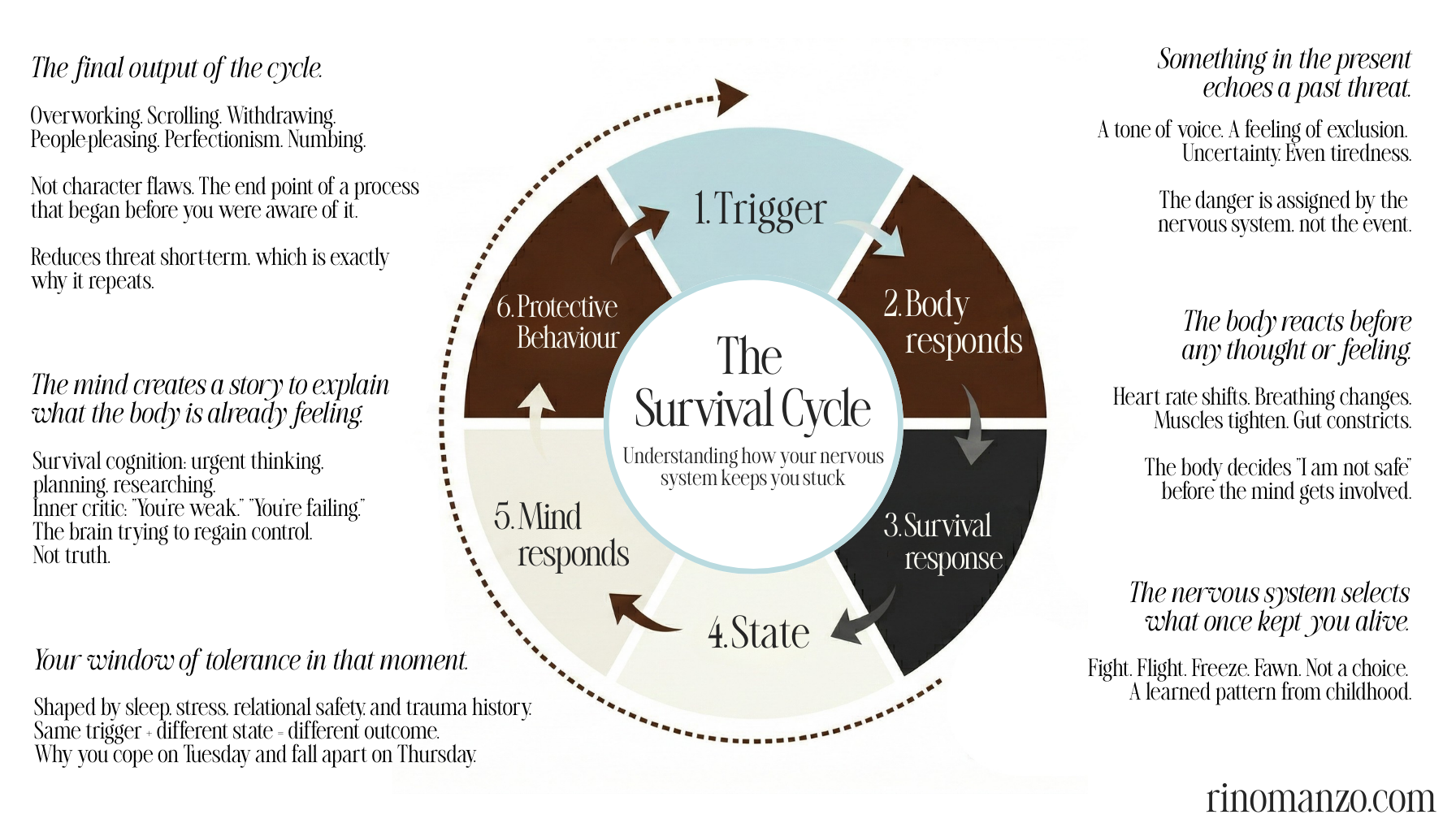
I often explain trauma through what I call the Survival Cycle. It shows what happens, step by step, when something in the present touches something unresolved in the body.
The cycle usually unfolds in the same way.
It starts with a trigger. An event or internal feeling that touches something old, such as shame, fear, uncertainty, or being seen.
Then the body reacts automatically. Breath changes. Muscles tighten. Heart rate shifts. Sometimes there is numbness. This happens before conscious thought.
Next comes the survival response. Fight, flight, freeze, or fawn. These are the patterns that once helped you cope.
The mind then tries to make sense of what is happening. Worry, urgency, self-criticism, or fear often show up here.
Behaviour follows to reduce the discomfort. This might be avoidance, overworking, pleasing others, numbing, or withdrawal.
Finally, short-term relief arrives. The threat eases for a moment. The body settles. But the cycle is reinforced, making it more likely to run again next time.
The Cycle Is Not the Enemy
People often tell me they can feel that something is off.
They talk about anxiety, low confidence, or feeling stuck. Often, this means the Survival Cycle is active.
Change does not start with fixing yourself. It starts with noticing.
"I am triggered."
"My body reacted."
"I am in the cycle again."
Therapy helps by slowing this process down, noticing the cycle together, and creating space where there was none before. If you are not sure whether therapy might help, that uncertainty is completely normal.
That is how the cycle begins to loosen.
Change Is Possible
For many people, understanding this is the first real shift. Not because everything suddenly feels better, but because blame is replaced with compassion.
You did not choose these patterns. Your body built them to protect you. And now, with the right support, they can begin to change.
A Soft Next Step
I am not currently taking on new clients, but I am keeping a waitlist. If something here has landed, you can add your name and I will be in touch as soon as a space opens. No pressure and no commitment, just a way to stay connected for when the time feels right.
Frequently Asked Questions
-
Trauma is not just what happened to you. It is what happened inside you as a result. It is the way your body and mind adapted to experiences that felt too much, too fast, or too alone. Those adaptations often stay with you long after the original experience has passed.
-
Yes. Childhood experiences shape the way your nervous system develops, how you relate to other people, and how you cope under pressure. Many adults carry patterns from childhood without realising where they come from. These patterns can show up as anxiety, difficulty in relationships, emotional numbness, or a constant feeling of being on edge.
-
The Survival Cycle is a way of understanding how trauma responses repeat. A trigger in the present activates a body memory from the past. The body reacts with a survival response such as fight, flight, freeze, or fawn. The mind creates a story to explain the feeling, and behaviour follows to bring short-term relief. The cycle then resets, often without the person realising what has happened.
-
No. Trauma can come from a single overwhelming event, but it can also come from ongoing experiences of neglect, emotional absence, or unpredictability in childhood. What matters is not the size of the event but the impact it had on you at the time and whether you had support to process it.
-
Therapy provides a safe space to slow down and understand what your body and mind have been carrying. It helps you recognise the patterns that developed as survival responses and begin to separate past experiences from present reactions. The aim is not to forget what happened but to reduce its hold on your daily life.
Related Articles