Fight, Flight, Freeze, Fawn: Understanding Your Trauma Response
You have probably heard the phrase fight or flight. It is one of those things people say when they are explaining why someone snapped or ran from a situation. But fight and flight are only half the picture.
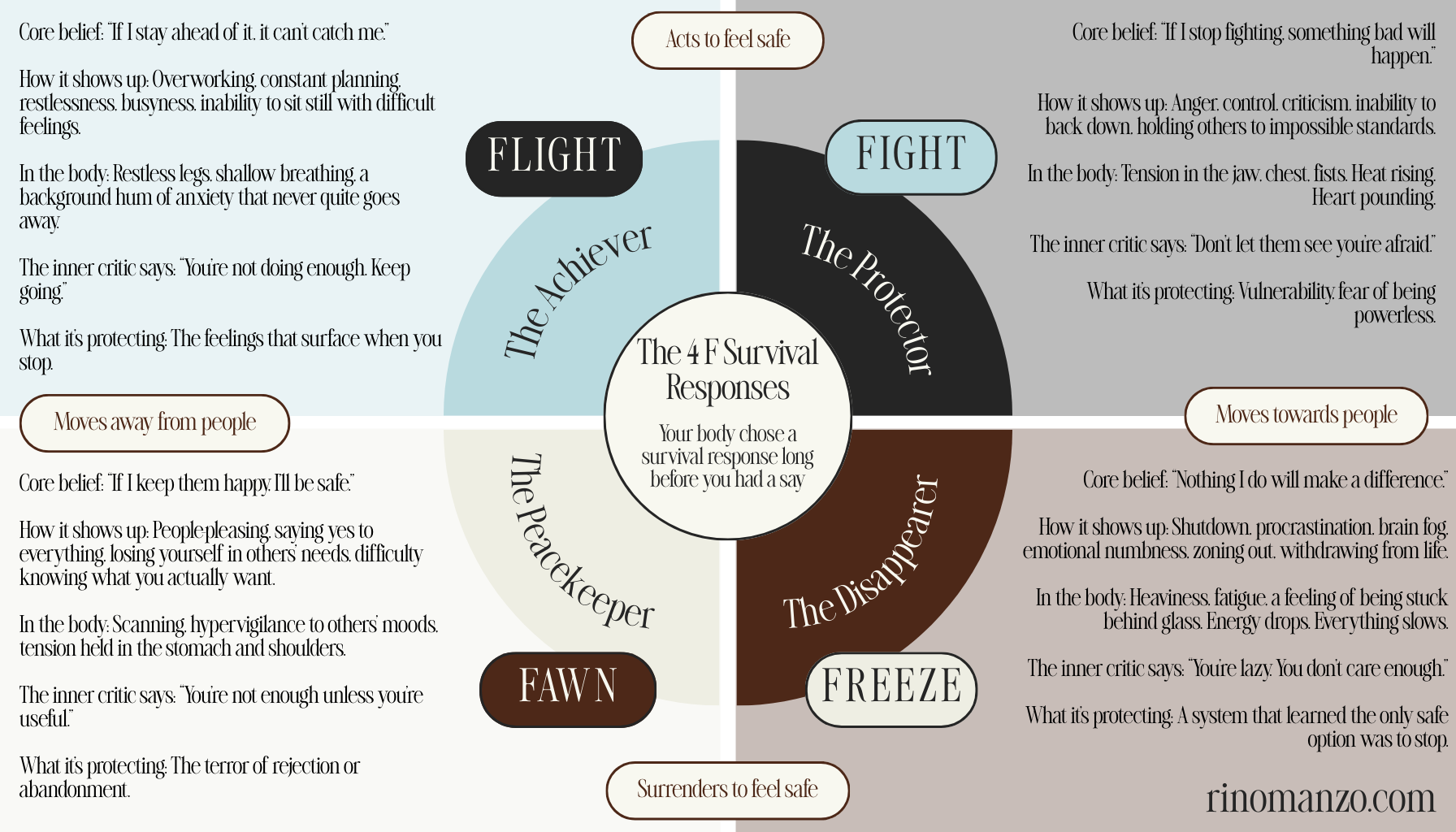
There are four trauma responses, not two. Fight, flight, freeze, and fawn. Your body learned at least one of them a long time ago, probably before you had any say in the matter. It chose the response that gave you the best chance of staying safe in the environment you grew up in. And chances are, that response is still running now, long after the original danger has passed.
Understanding which survival response your body defaults to is not a personality quiz. It is the beginning of understanding why you react the way you do under pressure, in relationships, at work, and in the quiet moments when something does not feel right but you cannot explain why.
What is a trauma response?
When a human being faces something threatening, the body does not wait for a thoughtful decision. The nervous system takes over. It assesses the situation in a fraction of a second and launches the response it believes will keep you alive.
This is not a conscious choice. You do not decide to fight, run, freeze, or appease. Your body decides for you, based on what it learned when you were very young.
In a family where standing your ground worked, the body learns to fight. In a family where disappearing was the safest option, it learns to flee. In a home where nothing you did made a difference, it learns to freeze. And in a home where the threat was someone you depended on, the body often learns to fawn, to keep the peace at any cost.
These responses are not flaws. They are adaptations. They are the evidence that your body was doing its job, trying to protect you with whatever it had available. The problem is that they do not always switch off when the danger passes.
How your body picks a survival response
Your body does not randomly select a response. It reads the environment and calculates, in a way that happens far too fast for thinking, which strategy gives you the best chance.
Imagine a child with an older sibling who is bigger, stronger, and seven years older. Their father is unpredictable and aggressive. In that house, fighting back is not a safe option. The child is physically outmatched in every direction. So the body looks at what is left. Flight, freeze, or fawn. Whichever one reduces the danger most becomes the default.
That child does not choose to become quiet, or compliant, or invisible. The body makes that decision because it has to. And it practises that response so many times that by adulthood, it feels like personality. "I have always been a people pleaser." "I have always been the quiet one." "I have always kept busy." But those are not personality traits. They are survival strategies that were never updated.
Most people develop one dominant response, but many carry two or even three that activate depending on the situation. You might fight at work but fawn in relationships. You might freeze with authority figures but flee from emotional conversations. The body is reading each situation separately and deploying whatever it learned to trust.
The fight response
Danny does not think of himself as someone carrying trauma. He thinks of himself as someone who does not take rubbish from anyone. He is direct, sometimes too direct. He has been told he is intimidating, aggressive, difficult. At work, he is the one who challenges everything. In relationships, he is the one who escalates.
What Danny does not see is that his anger is not really about the person in front of him. It is about something much older. His body learned early that the best way to survive was to come out swinging. In his family, being passive meant being walked over. So he fights. He fights in meetings. He fights in arguments with his partner. He fights the GP who keeps him waiting. He fights because his nervous system still believes that if he stops, something bad will happen.
The fight response can look like anger, control, dominance, criticism, or an inability to back down. It can also look like perfectionism pushed outward, holding everyone around you to impossible standards because the alternative feels like chaos.
Underneath the fight response, there is almost always fear. The anger is the bodyguard. The vulnerability is the thing being guarded.
The flight response
Emma is always doing something. She is the busiest person you know. She has lists for her lists. She plans holidays six months ahead. She runs every morning, not because she loves running, but because if she stops, the feelings catch up.
Emma grew up in a home where things were unpredictable. She could not control what was happening around her, but she could control herself. She could be prepared. She could stay ahead of the danger by never standing still. As an adult, that has translated into chronic busyness, overwork, and a deep discomfort with doing nothing.
The flight response does not always look like running away. It can look like overachieving, workaholism, constant planning, restlessness, or an inability to sit with difficult feelings. It can look like someone who has their life together, when in fact they are running from something they have never stopped long enough to face.
People in flight mode often describe a background hum of anxiety that never quite goes away. They manage it by staying busy. The moment they stop, the hum gets louder.
The freeze response
Fred has been called lazy more times than he can count. He struggles to get started on things. He procrastinates. He zones out in conversations. When life gets overwhelming, he goes quiet and retreats. His friends think he does not care. His family think he is not trying. What they do not see is that Fred is not choosing to do nothing. His body has shut down.
The freeze response is what happens when the nervous system decides that fighting is too dangerous and running is not possible. The body goes still. Energy drops. The mind fogs over. It is the biological equivalent of playing dead, and it is not laziness or apathy. It is a survival strategy.
Fred grew up in a house where the conflict between his parents was constant and loud. There was nothing he could do to stop it. Fighting back made it worse. Leaving was not an option. So his body learned to disappear on the inside. He went numb. He switched off. And that pattern followed him into adulthood.
Freeze can look like depression, dissociation, emotional numbness, brain fog, chronic fatigue, or a feeling of being stuck in life without knowing why. Many people in a freeze state describe feeling like they are watching their own life from behind glass.
The fawn response: when people pleasing is a survival strategy
Amy is the kindest person in any room. She remembers birthdays. She checks in on friends. She volunteers for extra shifts. She says yes to everything. People love Amy, but Amy is exhausted.
Amy grew up with a parent whose mood dictated the atmosphere of the entire house. If her mother was happy, everyone was safe. If her mother was upset, anything could happen. So Amy learned to read the room. She learned to say the right thing, do the right thing, be whatever was needed to keep the peace. She became very, very good at looking after other people. What she never learned was how to look after herself.
The fawn response is the least well-known of the four, but it may be the most common, especially among people who were raised in emotionally unpredictable homes. It is the survival response that says: if I make them happy, I will be safe. If I am useful, I will not be abandoned. If I never cause trouble, I will be loved.
Fawning can look like people-pleasing, codependency, difficulty saying no, chronic self-sacrifice, a lost sense of identity, or relationships where you always give more than you receive. It can also look like being drawn to people who need fixing, because helping someone else feels safer than examining your own needs.
Can you have more than one survival response?
Yes. Most people do. You might recognise a dominant response but notice that others show up in different situations. A person who mostly freezes might shift into fawn when a relationship feels threatening. Someone who leads with fight at work might collapse into freeze at home.
Some people carry hybrid responses that blend two patterns together. Fight and fawn can combine into someone who is outwardly strong and assertive but privately cannot stop helping, fixing, and managing everyone else. Flight and freeze can create a pattern of frantic activity followed by total shutdown.
The combination depends on what you learned and where you learned it. Your body developed a toolkit, and it reaches for different tools depending on what the current situation reminds it of.
How the Survival Cycle keeps these patterns running
Whatever your default response, it does not operate in isolation. It runs as part of a repeating loop that I call the Survival Cycle.
A trigger arrives. It does not have to be dramatic. A tone of voice. A feeling of being left out. A sense that someone is disappointed in you. The trigger touches something old, something unresolved, and the body responds before the mind has caught up.
Then comes the survival response. Danny fights. Emma runs. Fred shuts down. Amy appeases. The response brings short-term relief. The argument is won. The to-do list is completed. The feelings are numbed. The other person is placated. But the relief does not last, because the underlying wound was never addressed. The cycle resets, and it waits for the next trigger.
Understanding your place in this cycle is not about blaming yourself for reacting. It is about seeing the pattern clearly enough to start making different choices.
What changes when you understand your survival response
Knowing your default response does not make it disappear. But it changes your relationship with it.
When Danny recognises that his anger is a fight response, he can pause before reacting. He can notice the fear underneath and choose whether to act on it. When Emma notices that her urge to plan everything is flight, she can let herself sit still for a moment without the world ending. When Fred sees that his shutdown is freeze, he can stop calling himself lazy and start understanding what his body is doing. When Amy realises that her people-pleasing is fawn, she can begin to ask what she actually wants, not just what everyone else needs.
That is what awareness does. It does not remove the response. It creates a gap between the trigger and the reaction. And in that gap, there is room for something different.
How therapy helps you understand your survival response

In person-centred therapy, there is no script and no set of techniques you are expected to follow. You lead the conversation. I listen. And together, we slow down enough to notice what your body is doing and why.
That might mean exploring where your response started. What your family was like. What you learned about safety, love, and conflict when you were young. It might mean sitting with feelings that have been pushed down for a long time, because one of the ways survival responses work is by keeping those feelings at a distance.
The aim is not to get rid of your survival response. It kept you safe once, and it deserves respect for that. The aim is to loosen its grip so that you can respond to the present based on what is actually happening, rather than what happened twenty or thirty years ago.
A Soft Next Step
I am not currently taking on new clients, but I am keeping a waitlist. If something here has landed, you can add your name and I will be in touch as soon as a space opens. No pressure and no commitment, just a way to stay connected for when the time feels right.
Frequently Asked Questions
-
Fight, flight, freeze, and fawn are four survival responses that your nervous system uses when it detects a threat. Fight means confronting the danger. Flight means escaping from it. Freeze means shutting down and going still. Fawn means appeasing the source of danger to stay safe. These responses are automatic and are shaped by your earliest experiences.
-
Your body freezes when it has learned that fighting and running are not safe options. This often develops in childhood environments where there was no escape and resistance made things worse. The freeze response is not a choice or a weakness. It is your nervous system protecting you the only way it knows how.
-
It can be. When people-pleasing is driven by a deep fear of conflict, rejection, or abandonment, it may be the fawn survival response. This pattern often develops in childhood when keeping a caregiver happy was the safest way to avoid harm. Not all people-pleasing is trauma-related, but if it feels compulsive and leaves you exhausted, it is worth exploring where it started.
-
Yes. Most people have a dominant response but carry others that activate depending on the situation. You might freeze at home but fight at work, or fawn in relationships but flee from emotional conversations. Your body reads each situation and selects the response it trusts most for that context.
-
There is no single most common response, as it depends on individual experience. However, fawn and freeze are increasingly recognised as extremely widespread, particularly among people who experienced emotional neglect or grew up in households with unpredictable caregivers. Fight and flight tend to receive more attention because they are more visible, but the quieter responses are just as significant.
-
Pay attention to what happens in your body when you feel threatened or stressed. Do you get angry and want to push back? That may be fight. Do you feel an urge to leave, stay busy, or avoid? That may be flight. Do you go blank, numb, or shut down? That may be freeze. Do you immediately try to manage the other person's feelings? That may be fawn. A therapist can help you understand your patterns more clearly.
Related Articles