The Trauma Response Cycle: How Your Body Learned to Protect You
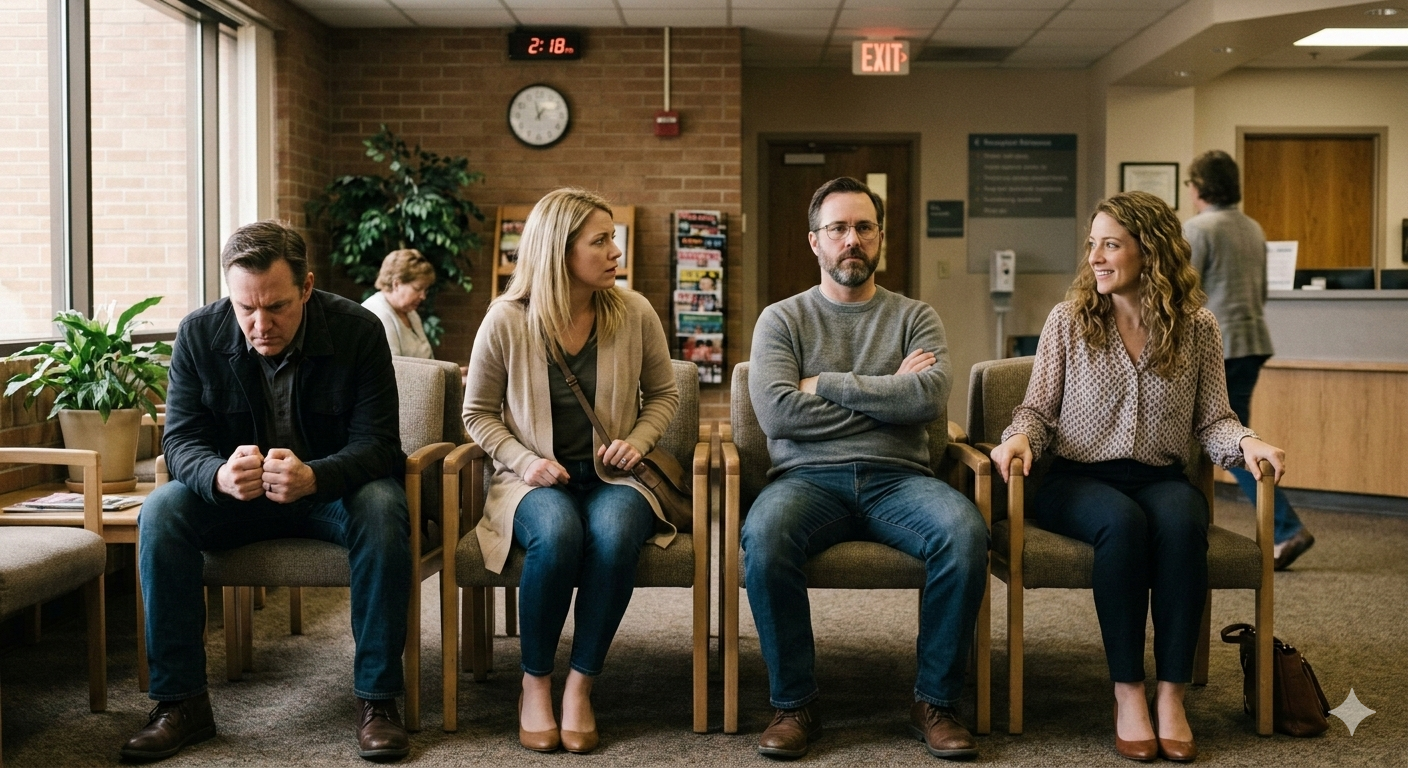
You notice it in the small moments first. A tone of voice that makes your stomach drop. A message left on read for too long. A look from someone across the room that takes you somewhere you cannot quite name. Before you have had time to think about what is happening, your body has already decided for you.
Your chest tightens. Your breath changes. Your jaw clenches or your mind goes blank. You snap at someone you love, or you smile and say everything is fine when it is not. You pour yourself into work, or you retreat to bed and stare at the ceiling. And afterwards, when the wave passes, you are left wondering what just happened and why you keep ending up here.
This is not a flaw. It is not weakness, and it is not something wrong with your personality. What you are experiencing is your trauma response cycle at work. It is a pattern your body learned a long time ago, and it has been running ever since.

What Is the Trauma Response Cycle?
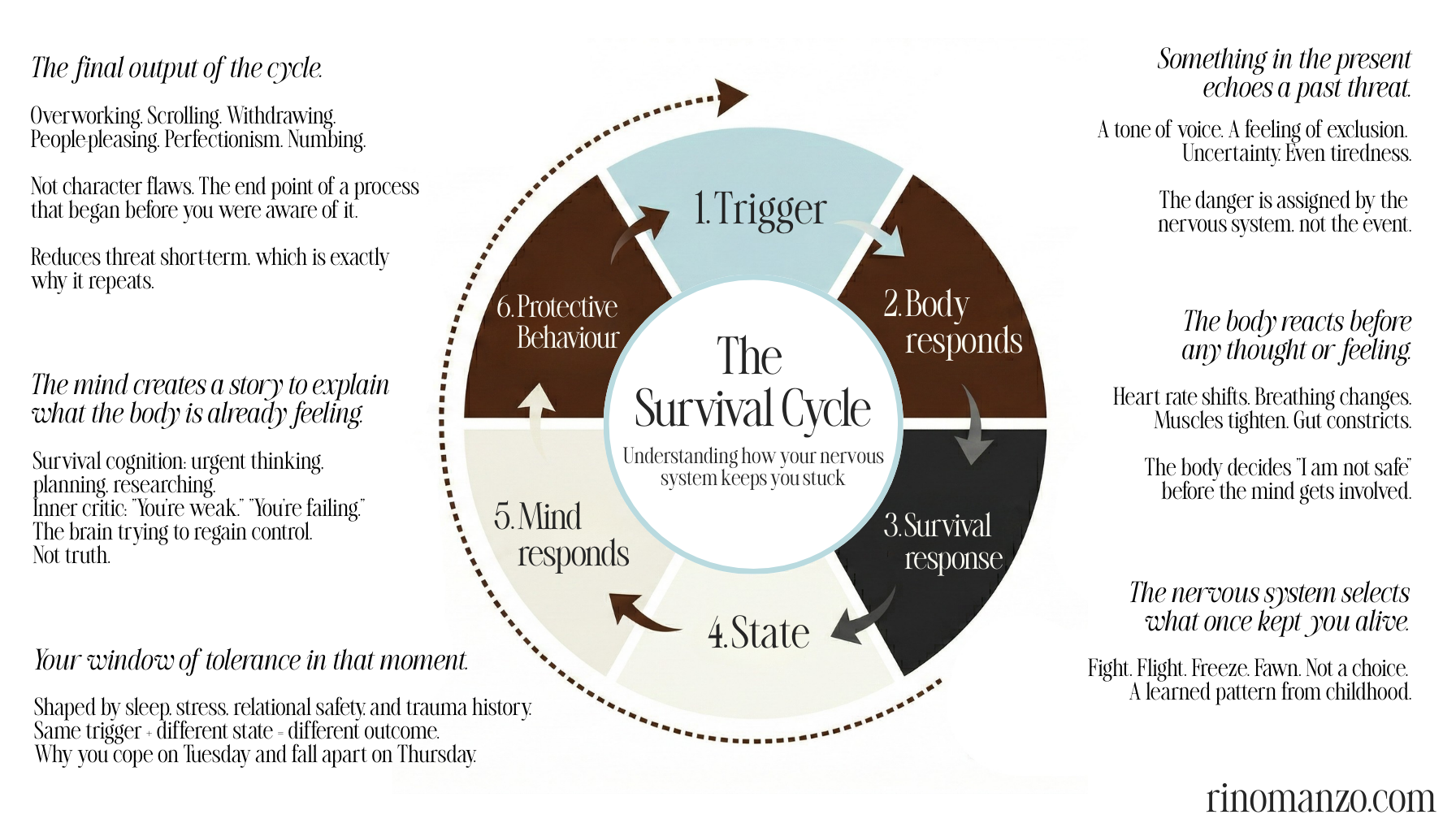
The trauma response cycle is a six-stage pattern that describes how your body and mind react to perceived threat. It starts in the body, not in the mind. That distinction matters more than almost anything else in understanding why you do what you do under pressure.
Most people believe their thoughts come first. Something happens, they think about it, and then they react. But that is not how it works. The body responds to threat faster than conscious thought can keep up. By the time you are aware of what you are feeling, your nervous system has already chosen a survival strategy.
The six stages are: trigger, body responds, survival response activates, state, mind responds, and protective behaviour. Each stage leads to the next, and the cycle resets after the behaviour brings short-term relief. It is not a one-off event. It is a loop, and most people are running it multiple times a day without realising.
If you have read What Is Trauma?, you will already know that trauma is not just about what happened to you. It is about what your body learned from what happened. The trauma response cycle is the mechanism through which that learning plays out, day after day, often without you realising it.
Stage One: The Trigger
Every cycle starts with a trigger. This is the event, sensation, or interaction that sets the whole process in motion. Sometimes the trigger is obvious. Someone raises their voice. You receive bad news. A relationship shifts unexpectedly.
But most triggers are not obvious at all. They are subtle. A certain smell. A particular quality of silence. The way someone turns away when you are speaking. Your body recognises something your conscious mind has not registered yet, and it responds to what the moment reminds it of, not necessarily to what is actually happening right now.
This is why the reaction can feel disproportionate. You are not reacting to the present moment alone. You are reacting to every time something like this happened before.
Stage Two: The Body Responds
This is the stage most people skip over, and it is the most important one. Before any thought forms, before any story takes shape in your mind, your body has already shifted. Your nervous system has detected threat and begun to mobilise.
What this looks like varies from person to person. For some it is a tightening in the chest. For others, a sinking feeling in the stomach. Your heart rate changes. Your muscles tense. Your breathing becomes shallow, or it feels like the air has been pulled out of the room. Some people feel a rush of heat. Others go cold.
The key point is that this happens before cognition. Your body is not waiting for your permission. It is not consulting your rational mind. It has learned, from experience, that something like this requires immediate action, and it acts.
This is why telling yourself to "just calm down" rarely works. You are trying to use your thinking brain to override a response that started below the level of thought. The body got there first.
Stage Three: The Survival Response
Once your body has registered threat, it activates one of four survival responses: fight, flight, freeze, or fawn. These are not choices you make. They are automatic strategies your nervous system developed to keep you safe.
Which response you default to depends on what worked, or what was safest, when you were growing up. Over time, one or two of these responses become your go-to pattern, the thing your body does without asking.
If you want to understand these four responses in more detail, Fight, Flight, Freeze, Fawn: Understanding Your Survival Responses explains each one and how they show up in everyday life. But here is how each one fits into the cycle.
Danny is the fighter. When the trigger hits and his body mobilises, it mobilises forward. His chest puffs out. His voice gets louder. He does not experience it as fear. It feels like anger, frustration, or a sudden need to take control. He argues. He pushes back. He gets defensive before anyone has actually attacked. His body learned early on that coming out swinging was the safest option, so that is what it does every time.
Emma runs. Not always literally, but her body floods with a restless, urgent energy. She cannot sit still. She reaches for her phone, starts planning, starts doing. If she can stay one step ahead, she does not have to feel what is catching up. Her diary is full. Her to-do list never ends. It looks like ambition from the outside. Inside, it is a body that learned the only safe place is somewhere else.
Fred goes still. When his body detects threat, it does not fight or run. It shuts down. His mind goes blank. He cannot find words. He stares at the wall or scrolls through his phone without registering a thing. People call him lazy or disengaged, but that is not what is happening. His nervous system has pulled the emergency brake. If you have ever wondered why you shut down in moments that should not feel that big, this is likely what is going on.
Amy soothes. Her body detects threat and immediately begins scanning for what other people need. She says yes when she means no. She smooths things over. She absorbs tension so nobody else has to feel it. From the outside she looks like the kindest person in the room. Inside, she has disappeared. If this sounds familiar, you might also recognise yourself in why you people please.
None of these responses is better or worse than any other. They are all strategies the body developed to survive. The problem is not the response itself. The problem is that the body keeps running the same strategy long after the original threat has passed.
Stage Four: Your State
This is the stage most people have never considered, and it changes everything about how the cycle plays out.
Your state is your window of tolerance in that moment. It is shaped by how much sleep you got, how much stress you are carrying, whether you feel safe in your relationships, and the weight of your trauma history. It is the reason the same trigger can produce completely different outcomes on different days.
On Tuesday, someone cancels on you and you feel a flicker of disappointment but move on. On Thursday, the same thing happens and you spiral. The trigger is identical. The difference is your state.
When your window of tolerance is wide, you have more capacity to absorb the trigger without the full cycle taking over. Your body still responds. The survival response still activates. But there is enough room in your system to notice it, to pause, to choose something different.
When your window is narrow, when you are tired, stressed, unwell, or already carrying unresolved feelings, the same trigger overwhelms your capacity. The cycle accelerates. The survival response hits harder. The mind gets louder. The behaviour follows faster. There is no gap to work with.
This is why people often say things like, "I do not know why I reacted like that, I was fine yesterday." You were not fine yesterday in the sense that nothing was wrong. You were fine because your state was wider. Today, it is not. And the body responds to the state it is in, not the state you think you should be in.
Danny does not always fight. On a good day, he notices the anger rising and lets it pass. On a bad day, the same comment from his partner sends him into a full confrontation. The trigger did not change. Danny's state did.
Stage Five: The Mind Responds
Only now, after the body has responded and the survival strategy has activated, does the thinking mind get involved. And when it does, it does not arrive fresh. It arrives already shaped by what the body is feeling.
If your body is in fight mode, your thoughts will sound aggressive or defensive. "They have no right to treat me like that." If your body is in flight, your thoughts will race with plans and worst-case scenarios. "I need to sort this out now, or everything will fall apart." If your body has frozen, your thoughts may feel distant or absent entirely. And if your body is fawning, your thoughts will focus on what everyone else needs. "Maybe if I just do this one thing, everything will be fine."
This is why your thoughts in these moments feel so convincing. They are not calm assessments of the situation. They are the mind scrambling to build a story around what the body is already doing. The thoughts feel true because the body got there first.
Stage Six: Protective Behaviour
Now the pattern becomes visible. This is the stage other people can see, and it is usually the stage people come to therapy wanting to change.
Danny raises his voice or sends the angry text. Emma throws herself into another project or books another commitment she does not have time for. Fred cancels plans and withdraws. Amy apologises for something that was not her fault and takes on even more of someone else's emotional weight.
The behaviours are different, but the purpose is the same. Each one is an attempt to reduce the discomfort the body is feeling. They are not chosen. They are driven by the survival response that activated in stage three.
This is also where the pattern causes the most damage in relationships, at work, and in how you feel about yourself. When the same behaviour keeps showing up in your life, it is worth asking what cycle is driving it. If you feel on edge all the time, your body may be running this cycle so frequently that you never fully come back to rest.
And for a moment, it works.
The behaviour works. For a moment. The anger burns off. The busyness distracts. The shutdown numbs the feeling. The people-pleasing smooths things over. The discomfort eases.
But it does not resolve. The underlying pattern, the thing the body learned, has not changed. It has just completed one loop. The cycle resets and waits for the next trigger. And the next trigger always comes.
This is what makes the trauma response cycle so persistent. It is self-reinforcing. The short-term relief confirms, to the body, that the strategy worked. So the body uses it again next time. And again. And again. Until the pattern becomes so automatic that it feels like who you are, rather than something you do.
Why Understanding the Trauma Response Cycle Changes Everything
When you see the cycle, something shifts. Not immediately, and not dramatically, but something real. You start to notice the gap between the trigger and the behaviour. You catch yourself in stage two, feeling your body react before the thought has arrived. You begin to recognise which survival response is running.
This does not mean you can stop it through willpower. The cycle is too fast and too deep for that. But awareness changes the relationship you have with the pattern. Instead of "I always lose my temper" or "I do not know why I cannot just say no," you begin to understand that your body is running a protection strategy it learned when protection was genuinely needed.
You are not broken. You are not weak. You are not "too sensitive" or "too much." Your body learned to survive, and it got very good at it. The work is not about stopping the cycle. It is about helping your body learn that the old threat is no longer here.
That is where therapy comes in. Working with a therapist who understands the trauma response cycle means starting with the body, not the thoughts. It means learning to notice what happens at stage two before stage five has taken over. It means building, slowly, a different relationship with the patterns that have been running your life. If you are not sure whether what you are experiencing is a trauma response, this guide to understanding trauma may help you make sense of it.

How Therapy Can Help
The trauma response cycle touches every part of life. It shapes how you handle stress, how you connect with people, and how you feel about yourself.
If your cycle shows up as anxiety, it may look like constant worry, overthinking, or a body that never fully relaxes. If it shows up as depression, it may feel like numbness, exhaustion, or disconnection from the things that used to matter. For many people the cycle is rooted in unresolved trauma that the body has been carrying for years.
The pattern can also drive chronic stress that never seems to ease, relationship difficulties that keep repeating, or a feeling that talking to someone might help but you are not sure where to start. All of these are doorways into the same cycle, and all of them can be worked with in therapy.
A Soft Next Step
I am not currently taking on new clients, but I am keeping a waitlist. If something here has landed, you can add your name and I will be in touch as soon as a space opens. No pressure and no commitment, just a way to stay connected for when the time feels right.
Frequently Asked Questions
-
The trauma response cycle is a six-stage pattern that describes how your body and mind react to perceived threat. The stages are trigger, body responds, survival response activates, state, mind responds, and protective behaviour. The cycle repeats because the behaviour brings short-term relief, which reinforces the pattern. Understanding the cycle is the first step toward changing your relationship with it.
-
The four trauma responses are fight, flight, freeze, and fawn. Fight involves anger, confrontation, or control. Flight looks like restlessness, overworking, or avoidance. Freeze is shutting down, going blank, or feeling numb. Fawn means people-pleasing, self-abandonment, or managing everyone else's emotions. Most people have a default response that their body returns to automatically.
-
Your nervous system processes threat faster than your conscious mind. The body is designed to act first and think later, because in genuine danger, that split-second matters. When your body has learned that certain situations are threatening, it activates this fast-track response even when the current situation is not actually dangerous.
-
You cannot stop the cycle through willpower alone, but you can change your relationship with it. Awareness of the pattern is the first step. Therapy helps by working with the body's responses rather than just the thoughts. Over time, the nervous system can learn that the old threat is no longer present, and the cycle gradually becomes less automatic.
-
Fight or flight is part of the trauma response cycle, but the cycle is broader. It includes two additional survival responses, freeze and fawn, as well as the stages that come before and after the survival response activates. The cycle also explains why these responses repeat and why the relief they bring is always temporary.
-
If you notice patterns in your life that feel automatic and disproportionate, such as shutting down during conflict, snapping under pressure, people-pleasing at your own expense, or staying constantly busy to avoid sitting with your feelings, these may be signs of a trauma response cycle. A therapist can help you identify which patterns are active and where they may have originated.
Related Articles